Posterior Cruciate Ligament Tibial Avulsion Fracture Following Low-Energy Trauma: A Case Report and Imaging Review
DOI:
https://doi.org/10.3941/jrcr.6114Abstract
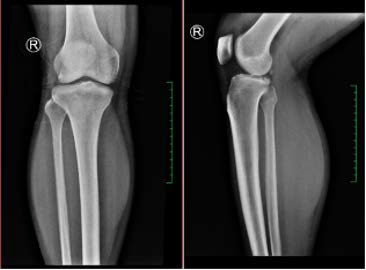
PCL avulsion fracture is a specific form of PCL injury. This fracture directly causes instability of the knee joint backwards, which will lead to increased pressure on the articular cartilage and eventually degenerative changes in the joint. Mr. D, 38 years old, came to the emergency room with complaints of falling and slipping. The patient fell in a semi-sitting position with the right knee bent inwards. After falling, the patient was unable to stand up and felt pain in the back of the knee. On physical examination were found edema, tenderness, posterior tibial sag, and posterior drawer test (+), with limited range of motion extension of the dextra genu joint. On radiological examination of the AP lateral genu dextra and CT scan of the right knee, an avulsion fracture was found in the intercondyloid posterior aspect of the tibia dextra. On MRI of the genu dextra, there was an avulsion fracture in the intercondyloid posterior aspect of the tibia dextra with PCL retraction. Based on the history and examination, the patient was diagnosed with Avulsion Fracture with Posterior Cruciate Ligament Injury. CT Scan and MRI are efficient examinations that can help establish the diagnosis of PCL.
Keywords: Magnetic Resonance Imaging (MRI), Medial Meniscus Injury, Joint Effusion, Posterior Cruciate Ligament Avulsion Fracture
Downloads
Published
Issue
Section
License
Copyright (c) 2026 Journal of Radiology Case Reports

This work is licensed under a Creative Commons Attribution-NonCommercial-NoDerivatives 4.0 International License.
The publisher holds the copyright to the published articles and contents. However, the articles in this journal are open-access articles distributed under the terms of the Creative Commons Attribution-NonCommercial-NoDerivs 4.0 License, which permits reproduction and distribution, provided the original work is properly cited. The publisher and author have the right to use the text, images and other multimedia contents from the submitted work for further usage in affiliated programs. Commercial use and derivative works are not permitted, unless explicitly allowed by the publisher.