Fusiform M2 Aneurysm Treated By Flow Diversion: Case Report
DOI:
https://doi.org/10.3941/jrcr.6016Abstract
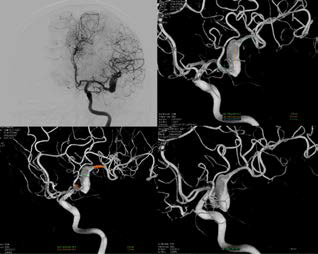
Fusiform cerebral aneurysms are uncommon vascular lesions, comprising approximately 3–13% of all intracranial aneurysms. The vertebrobasilar system represents the most frequent site of occurrence, while in the anterior circulation, the middle cerebral artery (MCA) is predominantly affected, followed by the internal carotid and anterior cerebral arteries. The pathogenesis of MCA fusiform aneurysms is primarily attributed to arterial dissection, atherosclerosis, or connective tissue disorders. Clinically, these aneurysms present with a spectrum of manifestations, including intracranial hemorrhage, cerebral ischemia, seizures, or mass effect, contingent upon their location, size, and extent of vascular involvement. The management of MCA fusiform aneurysms remains challenging due to anatomical complexities and technical difficulties associated with both open surgical and endovascular interventions. This report describes a case of a giant fusiform aneurysm located in the M2 segment of the MCA, successfully treated through an endovascular approach, highlighting the efficacy of this technique in complex neurovascular pathology.
Downloads
Published
Issue
Section
License
Copyright (c) 2026 Journal of Radiology Case Reports

This work is licensed under a Creative Commons Attribution-NonCommercial-NoDerivatives 4.0 International License.
The publisher holds the copyright to the published articles and contents. However, the articles in this journal are open-access articles distributed under the terms of the Creative Commons Attribution-NonCommercial-NoDerivs 4.0 License, which permits reproduction and distribution, provided the original work is properly cited. The publisher and author have the right to use the text, images and other multimedia contents from the submitted work for further usage in affiliated programs. Commercial use and derivative works are not permitted, unless explicitly allowed by the publisher.